When did you last order from Amazon?
Perhaps it was yesterday or even just an hour ago. More and more people are using Amazon and other web services. In 2025, Amazon estimated it had 310m active users, with a million new users joining every year.
SITUATION: NEW ROCKET FUEL
With this level of growth, it’s no wonder large web service companies are looking to increase the size and capability of their satellite network. At the same time, they want to scale economically as possible.
This has led to investment in new rocket fuels for launching satellites. Space launch vehicles have traditionally relied on propulsion systems using liquid oxygen and hydrogen. However, hydrogen is challenging to use due to being extremely cold, prone to leaking, and expensive.
Methalox is emerging as a lower-cost alternative that makes use of liquid oxygen (LOX) and methane instead. This new usage of two volatile cryogenic liquids is driving a need for rigorous testing to properly understand the risks of using methalox and develop appropriate safety protocols.
ACTION: TESTING
NASA is leading a project to measure the size and strength of explosions generated by mixing varying quantities of LOX and methane. The controlled explosions simulate a range of failure scenarios, for example, a failure in the propellant feed lines or of the bulkhead between the two propellant tanks.
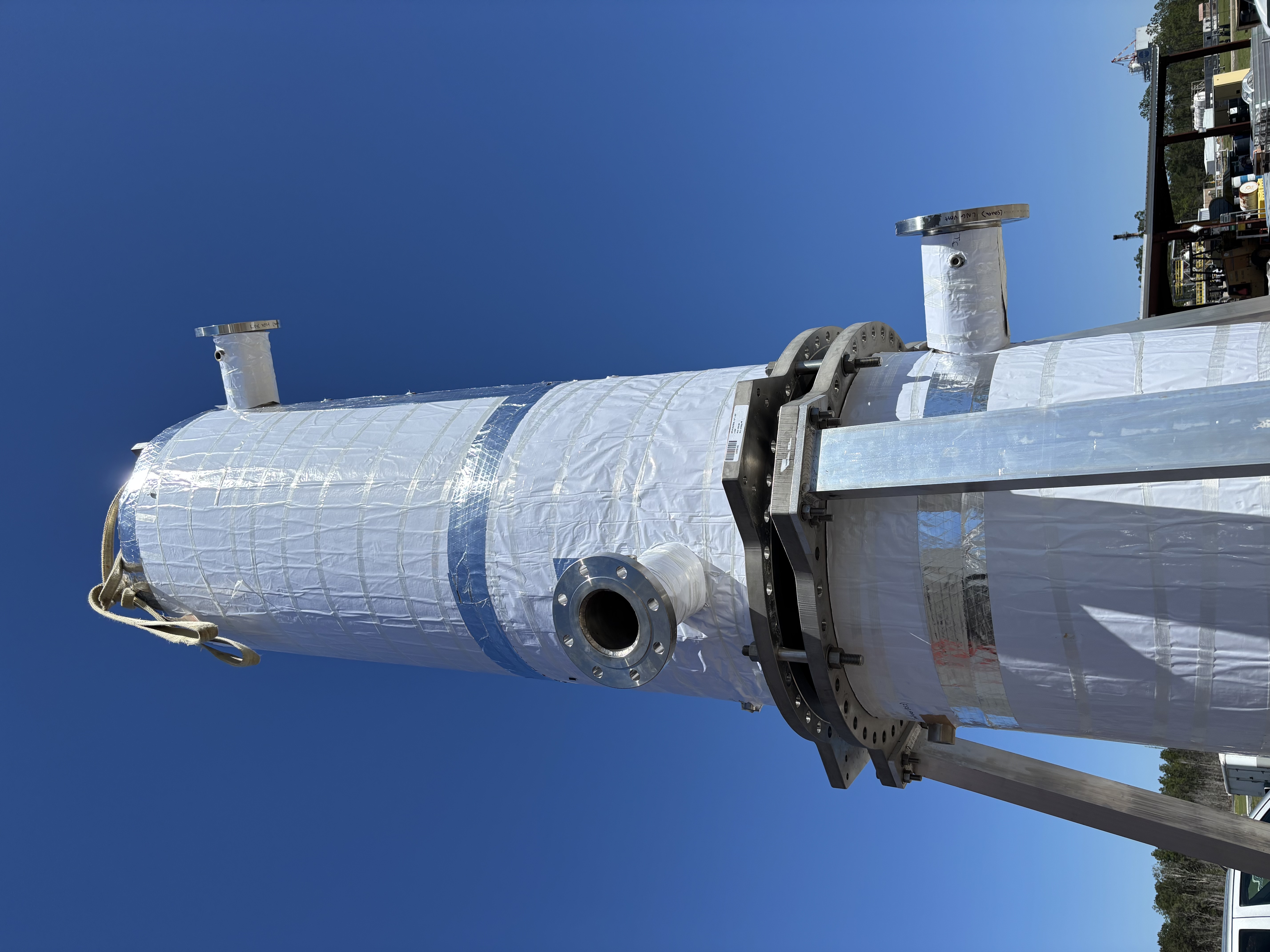
Rupture discs play a central role in the test setup. They act as a leak-tight barrier between the LOX and methane, and are set to burst at a defined pressure to allow controlled mixing of the two fluids. The technical requirements for these discs are demanding: They must operate reliably at cryogenic temperatures, achieve low burst pressures, withstand back pressure, and be manufactured at large diameters of up to 42 inches.
Using our in-house engineering expertise, OsecoElfab developed a solution that met these specifications, and we delivered the discs within the required timeframe for testing.
RESULT: SAFETY PROTOCOLS
The discs were installed as planned and the testing carried out. Sensors measured the intensity of the pressure wave, the temperature, and how far and fast the debris travels.
This new test data will be used to develop safety protocols for methane-based propulsion systems, contributing to public safety, site safety, and application safety for years to come.